Getting your Commercial Driver’s License (CDL) can open the door to a new career in trucking, transportation, and other industries that depend on qualified commercial drivers. But before you can get behind the wheel professionally, there’s an important decision to make:
Where should you get your CDL training?
Not every CDL training program offers the same experience. The school you choose can affect how prepared you are for your CDL skills test, how confident you feel behind the wheel, and how smoothly you can make the transition from student to professional driver.
There are also federal requirements prospective students should understand. For many new CDL applicants, simply enrolling in any program isn’t enough. Required Entry-Level Driver Training (ELDT) must be completed through a provider listed on the Federal Motor Carrier Safety Administration’s Training Provider Registry (TPR). (FMCSA)
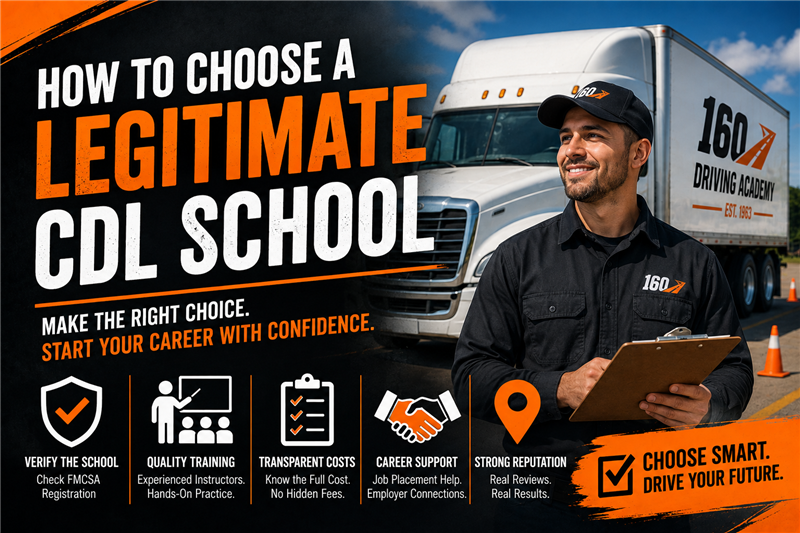
Here’s what to look for when choosing a legitimate CDL school in 2026.
1. Start With the FMCSA Training Provider Registry
One of the first things you should do when researching a CDL school is check the FMCSA Training Provider Registry.
Federal ELDT regulations apply to many drivers who are:
- Getting a Class A CDL for the first time
- Getting a Class B CDL for the first time
- Upgrading from a Class B CDL to a Class A CDL
- Obtaining a passenger (P), school bus (S), or hazardous materials (H) endorsement for the first time
If ELDT applies to you, the required training must be completed with a provider listed on the Training Provider Registry. (FMCSA)
The TPR allows prospective students to search providers by training type, location, and provider name. After you successfully complete required training, the provider submits your training certification to FMCSA. (FMCSA TPR)
Before paying a school, search for the specific provider and training location in the TPR.
That's an important first step in protecting yourself and making sure your training will count toward meeting applicable federal requirements.
One important distinction: being listed in the Registry does not mean FMCSA has endorsed or certified a particular school. Training providers self-certify that they meet applicable requirements, and FMCSA specifically states that providers should not advertise themselves as “FMCSA approved” or “FMCSA certified.” (FMCSA TPR)
2. Understand What CDL Training You're Actually Getting
A legitimate CDL program should clearly explain what is included in your training.
Ask questions such as:
- Does the program include both classroom/theory and behind-the-wheel instruction?
- What CDL class is the program designed for?
- How much behind-the-wheel training will I receive?
- What equipment will I train on?
- What skills will I practice?
- How does the program prepare students for the CDL skills test?
- Are there additional state requirements I need to complete?
Federal ELDT requirements establish minimum standards for applicable training. Providers listed in the TPR must self-certify that they meet requirements covering areas including curriculum, facilities, vehicles and equipment, instructors, and applicable state requirements. (FMCSA TPR)
States can also impose requirements beyond the federal minimums, making it important to understand the rules where you plan to obtain your CDL. (FMCSA TPR)
A reputable school should be able to explain exactly what you'll learn and how the training process works.
3. Look for Real Behind-the-Wheel Training
Learning CDL concepts is important.
Actually operating a commercial vehicle is different.
Behind-the-wheel training gives students the opportunity to develop practical skills with an instructor, including vehicle control and other skills required by the applicable curriculum.
When evaluating schools, don't just ask whether behind-the-wheel training is included. Ask what that training actually looks like.
You may want to ask:
How much time will I personally spend driving?
What kinds of vehicles will I train on?
How many students typically share a truck during training?
What happens if I need additional practice?
FMCSA requires registered providers offering behind-the-wheel ELDT to meet applicable requirements for vehicles, facilities, instructors, and curriculum. (FMCSA)
Understanding how a school delivers that training can help you compare programs beyond price alone.
4. Ask About the Instructors
A CDL school is only as useful as the training students receive.
Ask prospective schools about their instructors' qualifications and commercial driving experience.
FMCSA establishes qualification requirements for instructors providing Entry-Level Driver Training. Registered training providers must use instructors who meet applicable federal and state requirements. (FMCSA)
But qualifications are only part of the equation.
Good instructors should also be able to communicate clearly, explain difficult maneuvers, provide constructive feedback, and help students develop safe driving habits.
When visiting a school, pay attention to how instructors interact with students.
5. Visit the CDL Training Location
Whenever possible, visit the training location before enrolling.
A website can tell you what a school promises. Seeing the facility can give you a better idea of what your training experience may actually look like.
Look at:
- The training range
- Trucks and equipment
- Classrooms
- Overall organization
- Condition of training vehicles
- Number of students
- Access to instructors
Ask whether you can see where behind-the-wheel training takes place.
A professional CDL school should be comfortable explaining how its training environment works.
6. Get the Full Cost of CDL Training
Price matters, but the lowest advertised price isn't necessarily the best value.
Before enrolling, ask for a clear explanation of the program's costs and policies.
Questions should include:
- What is the total tuition?
- Are there registration or administrative fees?
- Are books or training materials included?
- Are testing fees included?
- Are there additional charges for extra training?
- What is the cancellation or refund policy?
- Are financing or funding options available?
FMCSA itself recommends interviewing multiple providers and asking about fees, enrollment policies, availability, and applicable federal and state requirements before choosing a school. (FMCSA TPR)
You should understand what you're agreeing to before signing an enrollment agreement or making a payment.
7. Be Careful With Employment and Salary Promises
A CDL can create access to many career opportunities, but be cautious of anyone promising a guaranteed job or a specific salary without clearly explaining the conditions.
Truck driver compensation can vary based on factors such as:
- Employer
- Experience
- Location
- Route type
- Miles or hours worked
- Type of freight
- Endorsements
- Compensation structure
Similarly, employment opportunities can depend on your driving record, qualifications, employer hiring standards, and local job market.
A credible CDL school should help you understand career opportunities without making unrealistic promises.
Ask what career services the school provides and what those services actually include.
8. Ask About Job Placement Assistance
Getting your CDL is the goal of training, but for many students, the bigger goal is starting a career.
Ask the school what happens after training.
Does it provide career services? Does it help students connect with employers? Are students introduced to trucking companies that are hiring new drivers? Does the school help graduates understand what to expect during the hiring process?
Job placement assistance shouldn't be confused with guaranteed employment. But having resources available as you begin your job search can make the transition from training to professional driving easier to navigate.
9. Research the School's Reputation
Spend some time researching the school outside of its own website.
Look at online reviews, talk to former students if possible, and search for information about the school's history and locations.
Don't judge a school based on one positive or negative review. Instead, look for patterns.
Are students consistently talking about instructor quality?
Do people mention getting meaningful driving practice?
Are there repeated complaints about unexpected fees?
Does the experience described by students match what the school tells you during enrollment?
Reviews aren't perfect, but they can help you identify questions worth asking before making a commitment.
10. Watch for CDL School Red Flags
Certain warning signs should make you slow down and ask more questions.
Be cautious if a school:
- Cannot be found in the Training Provider Registry when ELDT registration is required
- Claims to be “FMCSA approved” or “FMCSA certified”
- Won't clearly explain its curriculum or training process
- Won't explain the total cost of attendance
- Pressures you to enroll immediately
- Makes unrealistic salary promises
- Guarantees employment without explaining conditions
- Is unclear about how much behind-the-wheel training you'll receive
- Won't explain its refund or cancellation policies
- Provides answers that don't match information from FMCSA or your state licensing agency
As of August 2026, FMCSA's Training Provider Registry itself distinguishes between active locations, locations under review, and locations that have been removed. The Registry also provides tools for students to search providers and check their own training records. (FMCSA TPR)
Doing your homework before enrolling is worth the effort.
Questions to Ask Before Choosing a CDL School
Before signing up, consider asking every school you're evaluating the same questions:
- Are you listed on the FMCSA Training Provider Registry for the training I need?
- Is this specific training location listed?
- What exactly is included in tuition?
- What does behind-the-wheel training look like?
- How much driving practice will I receive?
- What qualifications do your instructors have?
- What trucks and equipment will I train on?
- How does the program prepare me for the CDL skills test?
- What happens if I need additional training?
- What career or job placement assistance is available?
- What financing or funding options may be available?
- What are your cancellation and refund policies?
Compare the answers instead of choosing based on one factor alone.
How to Verify Your CDL Training
Your due diligence doesn't necessarily end once training starts.
After a student successfully completes required Entry-Level Driver Training, the training provider is responsible for electronically submitting certification information to FMCSA's Training Provider Registry.
FMCSA says providers are required to submit that information by midnight of the second business day after the driver completes training. Drivers can then use the Registry's Check My Record tool to see the information their provider submitted. (FMCSA TPR)
Your state licensing agency uses TPR information to verify completion of required training before administering applicable CDL skills or endorsement tests. (FMCSA TPR)
Choosing the Right CDL School Is an Investment in Your Career
Your CDL training shouldn't simply be about doing the minimum necessary to take a test.
You're preparing to operate large commercial vehicles professionally and safely.
That's why choosing the right CDL school matters.
Verify the provider. Understand the costs. Ask about behind-the-wheel training. Research the instructors and facilities. Understand the school's career resources. And don't be afraid to compare multiple programs before making your decision.
Start Your CDL Training With 160 Driving Academy
At 160 Driving Academy, we believe prospective drivers should know what they're signing up for and understand the road ahead.
Our CDL training programs are designed to help students build the knowledge and practical skills they need as they work toward earning their CDL and beginning a professional driving career.
With training locations across the country, 160 Driving Academy helps students take the next step toward opportunities in the transportation industry.
Ready to start your CDL journey?
Find a 160 Driving Academy location near you and learn more about CDL training today.
CDL and ELDT requirements may vary depending on license class, endorsements, individual circumstances, and state requirements. Students should confirm current requirements with FMCSA and the appropriate state licensing agency. Completion of training does not guarantee licensure, employment, or specific earnings.