If you're considering getting your Commercial Driver's License (CDL), one of the biggest questions you probably have is simple: How much can I actually make as a truck driver?
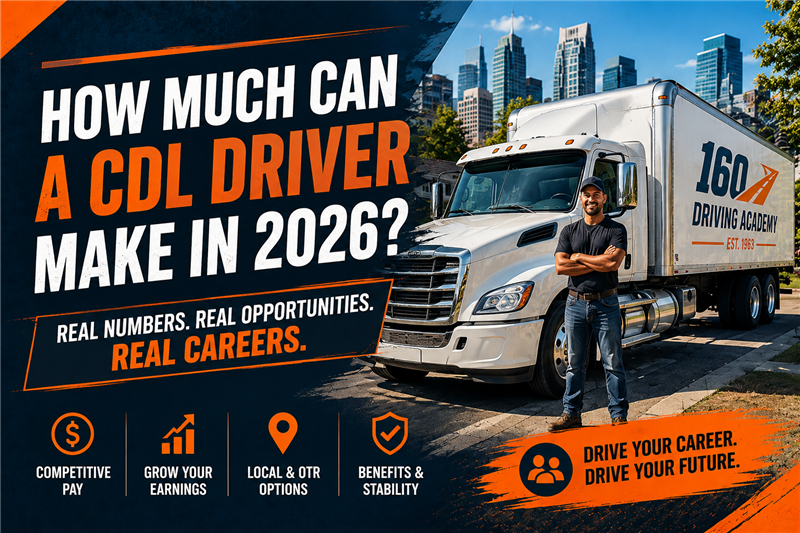
The answer depends on the type of driving you do, your experience, your endorsements, where you work, and the company that hires you. But a CDL can open the door to a wide range of driving careers—and some offer significantly higher earning potential as you gain experience.
According to the U.S. Bureau of Labor Statistics (BLS), the median annual wage for heavy and tractor-trailer truck drivers was $57,440 as of May 2024, the latest figure published in the Occupational Outlook Handbook. More recent BLS industry data shows that heavy and tractor-trailer truck drivers working specifically in the truck transportation industry had a 2025 median wage of $60,320 per year, or $29.00 per hour.
Those numbers provide a useful benchmark, but they don't tell the whole story.
How Much Do CDL Drivers Make?
There isn't one standard salary for everyone with a CDL.
Two drivers can hold the same class of CDL and earn very different amounts depending on their jobs. Your pay may be influenced by:
- Experience
- Employer
- Location
- Local, regional, or over-the-road routes
- Miles driven
- Type of freight
- CDL endorsements
- Specialized driving skills
- Pay structure, such as hourly, mileage, salary, or load-based compensation
That's why it's important to think about a CDL as more than a license for one specific job. It's a credential that can qualify you for multiple career paths.
What Is the Average Truck Driver Salary in 2026?
For someone researching truck driver pay in 2026, federal wage data provides a good starting point.
The BLS reports a $57,440 national median annual wage for heavy and tractor-trailer truck drivers based on May 2024 data. That works out to approximately $27.62 per hour.
Industry-specific BLS data for 2025 puts the median annual wage for heavy and tractor-trailer drivers in truck transportation at $60,320, with an average annual wage of $61,540.
Keep in mind that these are national figures. They aren't a guarantee of what a new CDL graduate—or any individual driver—will earn.
Your actual compensation can be higher or lower.
Can CDL Drivers Make More Than $60,000?
Yes. A national median means roughly half of workers earn more and half earn less, and experienced drivers may have opportunities to pursue jobs with greater earning potential.
Some of the factors that can help drivers pursue higher-paying opportunities include gaining experience, maintaining a strong driving record, adding endorsements, and developing the qualifications needed for specialized freight.
Depending on the employer and position, opportunities may include:
Hazmat Driving
Drivers transporting certain hazardous materials need a hazardous materials (H) endorsement. Because this work involves additional qualifications and responsibilities, some hazmat positions may offer higher compensation than general freight jobs.
FMCSA requires first-time applicants for the H endorsement to complete applicable Entry-Level Driver Training before taking the endorsement knowledge test.
Tanker Driving
Tank vehicles require an N endorsement, while drivers transporting qualifying hazardous materials in tank vehicles may need an X endorsement, which combines tank vehicle and hazardous materials qualifications.
Specialized tanker positions can create additional career opportunities for qualified CDL drivers.
Over-the-Road Trucking
Over-the-road, or OTR, drivers may travel long distances and spend days or weeks away from home.
BLS specifically notes that long-haul trucking can involve being away from home for extended periods.
For some drivers, the tradeoff of more time on the road can come with opportunities to earn more through additional mileage or different compensation structures.
Specialized Freight
Oversized loads and other specialized freight can require additional experience, training, permits, or qualifications.
These aren't necessarily jobs you'll step into immediately after earning your CDL, but they demonstrate why your first driving job doesn't have to define your entire career.
How Much Do New CDL Drivers Make?
New drivers shouldn't assume they'll immediately earn the same amount as experienced drivers.
Entry-level pay depends heavily on the employer, location, route, and compensation structure. Some companies may also offer benefits, bonuses, tuition reimbursement, or other incentives that affect total compensation.
Your first driving job can also serve another purpose: building experience.
As you accumulate safe driving experience, you may become eligible for additional positions, employers, routes, and specialized driving opportunities.
Think beyond your first paycheck.
When comparing CDL jobs, consider the complete opportunity:
Starting pay + benefits + schedule + experience + advancement potential.
A position that gives you valuable experience today may help qualify you for better opportunities later.
Does a Class A CDL Give You More Career Options?
For many prospective professional drivers, a Class A CDL provides access to a broad range of commercial driving opportunities.
Under federal standards, a Class A CDL covers qualifying combinations of vehicles with a gross combination weight rating or gross combination weight of 26,001 pounds or more when the towed unit exceeds 10,000 pounds.
A Class B CDL generally covers qualifying single vehicles weighing 26,001 pounds or more, as well as those vehicles towing units that do not exceed 10,000 pounds.
Class B drivers can have excellent careers, including opportunities involving buses, straight trucks and other commercial vehicles.
But if your goal is to drive tractor-trailers and pursue a wider variety of trucking positions, a Class A CDL may provide greater flexibility.
Do CDL Endorsements Help You Earn More?
They can help you qualify for more types of jobs.
FMCSA recognizes several CDL endorsements, including:
- H: Hazardous Materials
- N: Tank Vehicle
- X: Tank Vehicle and Hazardous Materials
- T: Double/Triple Trailers
- P: Passenger
- S: School Bus
Different endorsements require different testing and qualifications.
An endorsement doesn't automatically mean a higher paycheck. What it does is expand the types of commercial vehicles or freight you may be qualified to operate.
More qualifications can mean more career options.
Are Truck Drivers Still in Demand in 2026?
Truck driving remains a large occupation with significant projected hiring needs.
The BLS projects employment of heavy and tractor-trailer truck drivers to grow 4% between 2024 and 2034, approximately as fast as the average for all occupations.
More importantly for someone considering entering the industry, BLS projects approximately 237,600 openings for heavy and tractor-trailer truck drivers each year, on average, over that decade. Many of those openings are expected to result from workers leaving the occupation or exiting the workforce.
That means businesses will continue needing qualified drivers to move freight across the country.
Is Getting a CDL Worth It in 2026?
For someone who wants to enter a new career without following a traditional four-year college path, CDL training may be worth considering.
BLS lists a postsecondary nondegree award as the typical entry-level education for heavy and tractor-trailer truck drivers and notes that drivers usually attend professional truck driving school before entering the occupation.
Federal regulations also require first-time Class A and Class B CDL applicants subject to Entry-Level Driver Training requirements to complete applicable training with a registered provider before taking the CDL skills test.
Your CDL can then become the starting point for a career where your earning opportunities may grow as you build experience and qualifications.
Start Your CDL Career With 160 Driving Academy
Your earning potential as a professional driver starts with getting properly trained and earning your CDL.
At 160 Driving Academy, we help students take the first steps toward a professional driving career with CDL training designed to prepare them for the road ahead.
Whether your goal is local driving, regional routes, over-the-road trucking, or eventually moving into specialized freight, earning your CDL can give you the credentials needed to start pursuing those opportunities.
Ready to see where a CDL could take you?
Take the first step toward your new career and learn more about CDL training at 160 Driving Academy today.
Salary and employment figures are based on U.S. Bureau of Labor Statistics data and are provided for informational purposes only. Actual earnings vary by employer, location, experience, route, hours worked, endorsements, and other factors. 160 Driving Academy does not guarantee employment or specific earnings.