Graduating from CDL school is a major accomplishment. You’ve learned how to safely operate a commercial vehicle, practiced the skills you need for your CDL exam, and taken an important step toward a career in trucking.
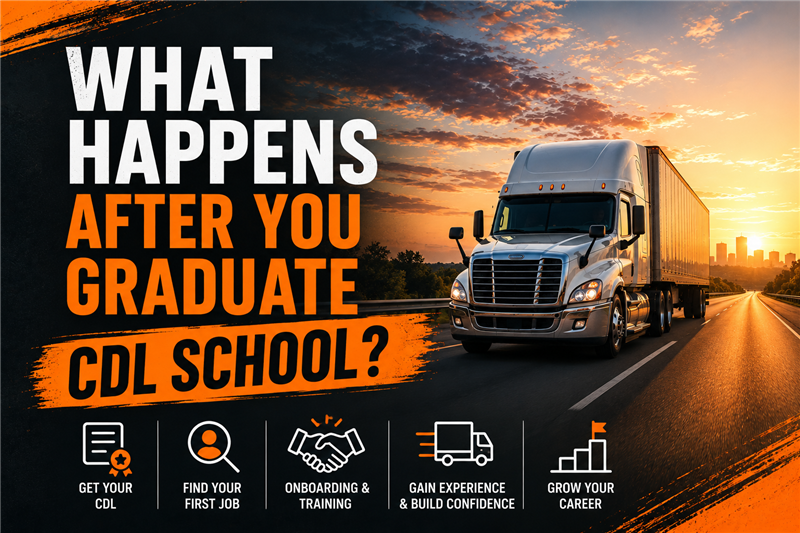
But what happens next?
For many new drivers, graduation is where the real journey begins. From finding your first job to gaining experience and building your career, the months after CDL school can shape your future in the trucking industry.
Here’s what new CDL graduates can expect.
Your First Step: Get Your CDL
Before you can start working as a commercial driver, you need to successfully complete the required testing and obtain your CDL.
Your training has prepared you for the knowledge and skills tests, but preparation shouldn't stop when you leave school.
Take the time to understand your license, any restrictions that apply, and which endorsements could expand your career opportunities.
Once you're licensed, you can begin pursuing opportunities with trucking companies.
Next Comes the Job Search
For many graduates, the next step is finding their first driving position.
This can feel intimidating, especially if you don't have professional driving experience yet. The good news is that trucking companies regularly hire entry-level drivers.
When searching for your first job, consider more than just the advertised pay.
Look at:
- Training and orientation programs
- Home-time policies
- Type of freight
- Equipment
- Route options
- Benefits
- Opportunities for advancement
Your first job is an opportunity to gain experience and learn what type of trucking career fits you best.
Your First Weeks on the Job May Include Additional Training
Don't expect to graduate from CDL school and immediately be handed the keys to a truck with no additional training.
Many carriers have their own onboarding and training programs. Depending on the company and position, you may spend time learning company procedures, equipment, routes, safety expectations, and other job-specific responsibilities.
You may also work alongside an experienced driver before operating independently.
This is a normal part of transitioning from student to professional driver.
Your First 90 Days Are About Building Good Habits
The first few months behind the wheel are important.
You're taking everything you learned in CDL school and applying it to real-world situations.
You'll begin learning how to handle things like:
- Different types of traffic
- Tight delivery locations
- Changing weather
- Fuel stops
- Customer interactions
- Dispatch communication
- Hours-of-service requirements
- Real-world trip planning
You won't know everything immediately. That's expected.
The goal is to keep learning while developing safe, consistent habits.
Experience Starts Adding Up
One of the biggest milestones after CDL school is simply gaining experience.
Your first year can teach you things that classroom and training-yard experience can't fully replicate.
As you build a professional driving history, you may become eligible for additional opportunities.
Depending on your goals, those could eventually include:
- Local driving positions
- Regional routes
- Long-haul positions
- Specialized freight
- Tanker work
- Flatbed
- Hazmat
- Dedicated routes
The more experience and qualifications you build, the more options you may have.
Your CDL Can Be the Beginning, Not the End
Getting your CDL doesn't mean you have to spend your entire career doing the same type of driving.
Many professional drivers use their initial experience as a foundation for advancement.
Over time, you may decide that you want to:
Earn additional endorsements
Additional qualifications can open doors to different types of freight and driving positions.
Move into specialized driving
Specialized freight can provide a different type of career path for experienced drivers.
Become a trainer
Experienced drivers may eventually have opportunities to help train the next generation.
Move into management
Your experience on the road can also become valuable if you eventually pursue fleet, operations, or safety roles.
Your first driving job doesn't have to define your entire career.
You'll Learn What Type of Trucking Fits You
One of the biggest advantages of getting real-world experience is discovering what you actually like.
Maybe you enjoy seeing different parts of the country.
Maybe you'd rather be home every night.
Maybe you prefer working with specialized equipment.
Maybe you like the consistency of a dedicated route.
You won't necessarily know the answer before you start.
That's okay.
Your first position can help you figure out what you want from your long-term trucking career.
Safety Doesn't Stop at Graduation
One of the most important things to remember is that CDL school isn't the finish line for safety training.
It's the foundation.
Professional drivers are responsible for making safe decisions every day, including when dealing with traffic, weather, equipment, fatigue, and unexpected road conditions.
Your reputation as a driver begins with the habits you establish early in your career.
A strong safety record can become one of your most valuable professional assets.
What 160 Driving Academy Does After Training
At 160 Driving Academy, the goal isn't simply to help students complete CDL training.
Students are preparing for what comes next: entering the trucking industry with the skills and confidence needed to begin a professional driving career.
Training focuses on the fundamentals students need to become safe, capable drivers, while career support helps connect graduates with opportunities after completing their training.
The transition from student to professional driver can feel like a big one. Having the right training and resources can make that transition easier.
Where Could You Be One Year After Graduation?
It's easy to focus on the immediate goal of getting your CDL.
But think bigger.
A year after graduating, you could have:
- A year of professional driving experience
- A stronger résumé
- A clean driving record
- New qualifications or endorsements
- A better understanding of the trucking industry
- A clearer idea of your long-term career goals
And it all starts with getting through CDL school and taking that first step into the industry.
Your CDL Is the Starting Line
Graduating from CDL school doesn't mean your journey is over. It means you've completed the first major step.
The next steps are where you turn your training into experience, your experience into opportunities, and your opportunities into a career.
If you're considering a career in trucking, 160 Driving Academy can help you build the foundation you need to get started.
Your first day as a professional driver may be the beginning of a career that takes you much further than you expected.