What the Industry Is Facing
The recent article from FreightWaves highlights a stark reality: the explosion of low-quality training providers—commonly called “CDL mills”—is eroding highway safety across the U.S.
Among the findings:
- Roughly 100,000 truck crashes annually are tied to driver error or inexperience.
- Thousands of “approved” training schools operate under minimal oversight and inconsistent state regulation.
- Some carriers are inadvertently hiring graduates of programs that delivered licenses without ensuring real competence.
The article argues that the driver shortage narrative often overlooks this root cause: it’s not just about having more drivers—it’s about having qualified drivers.
Steve Gold’s Perspective
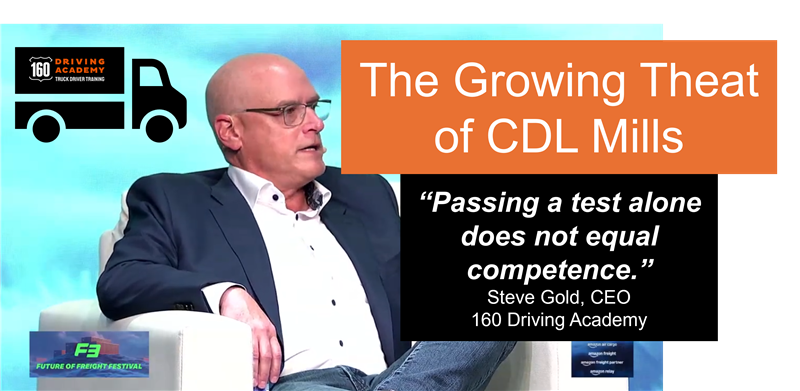
In the interview above and through his work at 160 Driving Academy, Steve Gold emphasizes that training excellence is non-negotiable.
His key points:
- Competence ≠ license: “Passing a test alone does not equal competence,” Gold says. Real training demands hands-on skill, analytics and ongoing assessment.
- Safety culture matters: He frames driver training not just as a business task but as a public-safety mission: “Safety is not just a box to check—it’s the culture we create for every driver who graduates from our program.”
- Eliminate bad actors: Gold calls for the removal of sub-standard training providers from the official registry and for carriers to scrutinize the training backgrounds of drivers.
- Carrier and trainer alignment: He stresses that carriers must partner with trainers who meet high standards and ensure drivers are ready for real-world conditions—from rooftop inspections to adverse-weather handling.
Why This Matters to Carriers, Trainers and the Public
- For carriers: Hiring under-trained drivers increases liability, crash risk and regulatory exposure. Working with quality training providers protects both reputation and bottom line.
- For training schools: Raising standards differentiates your program in a crowded field and helps build partnerships with carriers seeking vetted talent.
- For the public: Better-trained drivers mean fewer crashes, safer highways and fewer tragedies tied to preventable human error.
What We at 160 Driving Academy Are Doing
At 160 Driving Academy, Steve Gold and our team commit to:
- Rigorous hands-on training, beyond mere classroom time
- Transparent tracking of driver competency, not just test pass rates
- Collaboration with carriers to define what “qualified” means for real jobs
- Advocating industry-wide reforms: stricter state and federal oversight of training providers
The Way Forward
The “CDL-mill” problem isn’t going away by itself. The solution path includes:
- Stronger regulation: States and the Federal Motor Carrier Safety Administration (FMCSA) must ensure training providers are more than license factories.
- Carrier-Trainer transparency: Carriers should demand detailed training histories from drivers—not just proof of license.
- Industry culture shift: Training and hiring must value skill readiness over quantity of licenses issued.
Steve Gold’s view: When the industry prioritizes true competence over volume, we get safer roads, better drivers and stronger carrier-trainer relationships.
Final Word
The FreightWaves article delivers a clear warning: cheap shortcuts in driver training are a threat—not just to business but to public safety. Steve Gold and 160 Driving Academy stand on the front lines of this challenge. If you’re a carrier seeking drivers, a training school building your reputation, or simply someone who drives alongside commercial vehicles: demand more. More training. More verification. More safety.